In short
In the documents we read, terracotta facade cladding is an extruded fired-clay panel hung on an aluminium substructure. Argeton and NBK place their panels under EN 14411 (ceramic tiles); Moeding places its LONGOTON tiles under EN 1304 (clay roof tiles and fittings).[3][6][9] According to the German approvals, Argeton tiles are 30 mm thick (35 mm for one type at some heights) and class A1, NBK panels run from 33 to 80 mm, and Moeding LONGOTON is 40 mm and class A1.[3][6][9] Argeton's IBU EPD declares 30.9 kg CO₂e per m² for A1–A3; NBK's TERRART-large 40 annex declares 69.4 kg CO₂e per m² at a higher panel weight.[5][7] Vives's ventilated facade page and EPD describe porcelain tiles, not terracotta.[1][2]
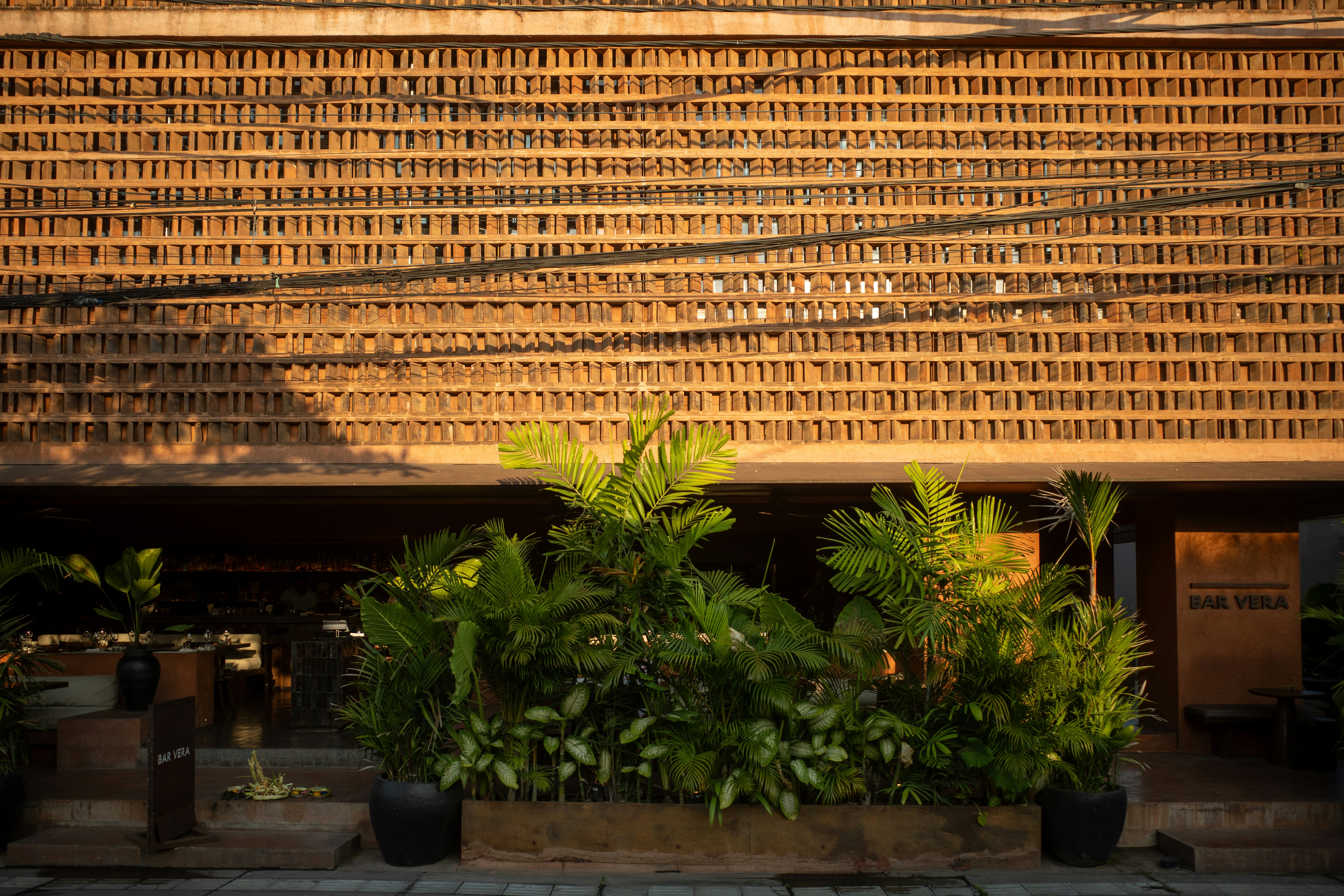
In the documents we read, the makers call their products ceramic facade panels or clay tiles (Argeton's approval and EPD, Moeding's approval); only the logo on NBK's EPD annex says "Architectural Terracotta". We use "terracotta" as the trade name for this kind of fired-clay facade panel. In the approvals they are extruded panels, often with hollow chambers, hung from aluminium profiles with a ventilated gap behind.[3][6][9][7] An earlier version of this article centred on Vives Ceramics. Vives's ventilated facade page speaks of porcelain tiles, and its EPD covers porcelain stoneware (group BIa), so this revision reads the documents of Argeton, NBK and Moeding and shows Vives only as a labelled contrast.[1][2] Every figure below is attributed to the document it comes from, and manufacturer statements are worded as claims.
Which standard does a terracotta facade tile follow?
It depends on the maker's approval, and this is the first thing to check in a specification. According to Argeton's approval Z-10.3-784 (2 June 2023), its tiles must be CE-marked extruded ceramic plates of group AIIa-2 to DIN EN 14411.[3] According to NBK's approval Z-10.3-957 (19 September 2025), its TERRART-LARGE vertikal plates must be extruded plates of group AIb, AIIa-1 or AIIb-1 to DIN EN 14411.[6] According to Moeding's LONGOTON approval Z-10.3-805 (7 September 2023), the tiles must be CE-marked clay roof tiles and fittings for external wall cladding to DIN EN 1304.[9] Moeding's ALPHATON approval Z-10.3-732 (19 December 2022) uses the same EN 1304 wording.[10]
DIN Media lists BS EN 14411:2016 as current and EN 1304:2013-05 as current; the Argeton and NBK approvals cite DIN EN 14411:2012-12.[11][12][3][6] NBK's approval refers to DIN 18516-1:2010-06 for the ventilated cladding, and DIN Media lists DIN 18516-1:2024-10 as the edition replacing it.[6][13] These approvals are German (DIBt) documents. According to Argeton's technical information, applicability is regulated by country-specific approvals, so a project elsewhere needs its own check.[4]
What do the manufacturers' documents declare?
| Maker and system | Format and thickness | Weight and density | Standard route, frost, bending | Fire | Source |
|---|---|---|---|---|---|
| Argeton: Tampa, Lineo, Terzo | Nominal height 100 to 500 mm, length up to 1,500 mm; thickness 30 mm; 35 mm for Tampa 12 mm at heights of 450 and 500 mm | Listed in the approval for heights of 450 and 500 mm: Tampa 8 mm 42 ± 4.5 kg/m² (30 mm); Tampa 12 mm 46 ± 4.5 kg/m² (30 mm) and 49 ± 5 kg/m² (35 mm); Lineo and Terzo 46 ± 4.5 kg/m² (30 mm). About 42 kg/m², about 59 kg/m² at 35 mm (technical information). Density at least 2.0 g/cm³ (technical information) | EN 14411, group AIIa-2; bending at least 13 N/mm² mean, 12 N/mm² single value (approval). Bending 12 to 20 N/mm², water absorption at most 9.0 %, 3 to 8 % in test reports (technical information) | A1 in the approval; "material class A1" under DIN 4102-4 in the technical information | [3][4] |
| NBK: TERRART-LARGE vertikal | Height 150 to 800 mm, width up to 1,800 mm; total thickness 33 to 80 mm (40 to 80 mm above 600 mm height) | Density 2.05 to 2.20 kg/dm³ (approval). TERRART-large 40: 57.0 kg/m² at 40 mm, 2,125 kg/m³ (EPD annex) | EN 14411, groups AIb, AIIa-1, AIIb-1; bending mean at least 23.0, 20.0 and 17.5 N/mm², lowest single value 18, 18 and 15 N/mm². The approval names thermal-shock resistance and durability for exterior use; frost is not named separately | Taken from the declaration of performance; class not read | [6][7] |
| Moeding: LONGOTON | Thickness 40 mm; maximum length 3,000 mm up to 600 mm height, 2,800 mm up to 650 mm, 2,500 mm up to 800 mm | At most 65 kg/m² on average; dry bulk density mean at least 1.80, minimum 1.75 g/cm³ | EN 1304; frost passed, method E, performance level 3 (150 cycles); breaking load 3,000 N mean, 2,560 N minimum at 400 mm height on a 1,000 mm span | A1 | [9] |
| Vives (porcelain, not terracotta): BIa tiles | 49 commercial formats, 9.4 mm average thickness; pressed, glazed | 20.87 kg/m² average fired weight | Group BIa; water absorption "0,5 %" in the performance table; frost resistance "Cumple" (complies) | Not stated in the EPD | [2] |
Where documents of one maker differ, we show both. Argeton's approval gives 42 ± 4.5 kg/m² for Tampa 8 mm and 49 ± 5 kg/m² for Tampa 12 mm at 35 mm, the technical information gives about 42 kg/m² and about 59 kg/m² for 35 mm, and the EPD declares an average of 40.35 kg/m² with an average thickness of 27 mm.[3][4][5] For water absorption, Argeton's technical information says at most 9.0 % and 3 to 8 % in test reports, and the EPD says 3 to 8 %.[4][5] We read no water absorption figure in the NBK or Moeding approvals, which give bulk density and bending values instead.[6][9]
What do the EPDs declare?
Both Argeton and NBK publish IBU declarations under EN 15804+A2. They are not like-for-like, because the declared modules and panel weights differ.
| EPD | Declared unit and weight | Dates | Modules declared | GWP-total | Source |
|---|---|---|---|---|---|
| Argeton, ceramic facade elements, EPD-AGT-20250103-CBC1-DE | 1 m² without substructure; 40.35 kg/m², average thickness 27 mm; 2022 data from the Görlitz plant | Issued 4 April 2025, valid to 3 April 2030; external verification box ticked | A1–A5, B (set to zero), C, D | A1–A3 30.9; A4 (100 km) 0.316; A5 0.961; C2 0.156; C4 0.608; D −0.388 | [5] |
| NBK, TERRART-large 40, annex to EPD-NBK-20240022-CBA1 | 1 m² unglazed panel; 57.0 kg/m², 40 mm; 2022 data | Issued 6 June 2024, valid to 5 June 2029 | A1–A3, A5, C1–C4, D (A4, B1, B2, B6 and B7 not declared; B3–B5 marked not relevant) | A1–A3 69.4; A5 0.627; C2 0.206; C3 0.118; D −0.282 | [7] |
According to the NBK annex, the result correlates strongly with surface weight and can be scaled linearly for 47 to 66 kg/m².[7] End-of-life scenarios also differ: the Argeton EPD sends the full 40.35 kg to an inert landfill, while stating that reuse of panels is possible in principle; the NBK annex sends 57.0 kg to recycling.[5][7] For service life, the Argeton EPD gives a reference service life above 50 years under the German BNB system, and its technical information says 50 to 60 years.[5][4] The Vives EPD we opened (GlobalEPD EN 17160-081, issued 23 March 2026) covers pressed porcelain tiles with an interior floor as its functional unit, so it does not describe a facade product, although it notes that these tiles can also be installed on facades.[2]
How are the panels fixed, and what governs fire?
Fixing. According to Argeton's approval, each tile is held form-fit at four points, by plate holders on vertical aluminium profiles (V-UK) or by clamps on horizontal profiles (H-UK), with aluminium joint profiles behind the vertical joints to stop rattling and lateral drift.[3] According to NBK's approval, panels are laid with the long axis vertical, self-weight is carried by plate carriers and wind load by plate holders, and vertical joints stay open at 10 mm.[6] According to Moeding's LONGOTON approval, the holders are extruded aluminium at least 30 mm wide on vertical profiles.[9] According to Vives's page, its porcelain system uses stainless clips in machined edge grooves with an MS adhesive cord, or a continuous hidden system with aluminium profiles.[1] In each case the approvals make structural proof project-specific.[3][6]
Fire. Class A1 for the tile is not the whole answer. According to Moeding's LONGOTON approval, the system is non-combustible, but that proof applies only on masonry or concrete walls, or on timber walls with a K260 non-combustible outer layer, with any insulation non-combustible and a gap of at least 20 mm.[9] According to Argeton's approval, the non-combustibility proof applies only on masonry or concrete walls, or on timber walls with a K260 non-combustible outer layer, with non-combustible insulation and a gap of at least 20 mm.[3] NBK's approval says the classification comes from the declaration of performance, which we did not read.[6]
What does independent research add?
Two peer-reviewed papers give context, and neither tests terracotta cladding. Ibáñez-Forés, Bovea and Simó (2011) assessed single-fired glazed stoneware tile using data from 35 Spanish enterprises, per m² over 20 years. They found that tile manufacture had the greatest impact in every category, followed by atomising the clay and distribution, linked to natural gas and fuel use.[14] Jones and colleagues (2021) ran four reduced-height BS 8414-1 fire tests on aluminium composite rainscreens with different insulations. They concluded that all facade products must be non-combustible, not only the outer panels.[15] That finding supports reading the system conditions above rather than the tile class alone. We did not find a peer-reviewed life cycle assessment of terracotta facade cladding.
What we could not check
- We could not open the PDF of NBK's TERRART-light 28 EPD (EPD-NBK-20240022-CBA1-EN). The machine-readable record we opened has an empty technical-data list, and the TERRART-large 40 annex says its technical data match TERRART-light.[8][7] We did not see the verification statement for the NBK annex.
- We did not read declarations of performance, test reports or the standards themselves, only DIN Media catalogue pages.[11][12][13]
- We did not check the IBU registry; the epd-online page redirected to a login.
- We found no terracotta facade product on the Vives pages we read, and no EPD for Moeding's facade tiles.[1]
Frequently asked questions about terracotta facade cladding
What is terracotta facade cladding?
In the manufacturer documents we read, it is an extruded, fired clay panel, often hollow, hung on an aluminium substructure with a ventilated gap behind it. Argeton, NBK and Moeding each describe their panels this way.
Which standard covers terracotta facade panels?
It depends on the maker's approval. Argeton's and NBK's German approvals require extruded ceramic plates to DIN EN 14411 (groups AIIa-2 for Argeton; AIb, AIIa-1 or AIIb-1 for NBK). Moeding's LONGOTON approval requires clay roof tiles and fittings to DIN EN 1304.
How thick and heavy are the panels?
According to Argeton's approval (2 June 2023) the nominal thickness is 30 mm, or 35 mm for Tampa 12 mm at heights of 450 and 500 mm, and the weight is 42 ± 4.5 kg/m² (Tampa 8 mm, 30 mm) to 49 ± 5 kg/m² (Tampa 12 mm, 35 mm). NBK's approval covers 33 to 80 mm. Moeding's LONGOTON approval states 40 mm and at most 65 kg/m² on average.
What fire class do terracotta facade panels have?
Argeton's and Moeding's LONGOTON approvals state A1 for the tiles. Both limit the non-combustibility proof to stated conditions, such as non-combustible insulation. NBK's approval refers to its declaration of performance, which we did not read.
Do these makers publish EPDs?
Argeton and NBK do. Argeton's IBU EPD (April 2025) declares 30.9 kg CO₂e per m² for modules A1 to A3 at 40.35 kg/m². NBK's TERRART-large 40 annex (June 2024) declares 69.4 kg CO₂e per m² at 57.0 kg/m². We found no EPD for Moeding's facade tiles.
Does Vives make terracotta facade cladding?
Vives's ventilated facade page, which we read on 8 October 2026, describes porcelain tiles. We found no terracotta facade product on the Vives pages we read.
Related reading
For a natural floor covering with a similar declared-data approach, see our cork flooring article.
Sources
- Vives Cerámica, "Ventilated Façades," technical solutions page, read 8 October 2026. Used for the statement that its facade solutions use porcelain tiles and for its three fixing systems. Manufacturer page; marketing claims on the page are not repeated. vivesceramica.com
- Vives Azulejos y Gres S.A. (AENOR GlobalEPD), Environmental Product Declaration "Baldosas cerámicas. Gres porcelánico (BIa)," registration GlobalEPD EN 17160 - 081, issued 2026-03-23, valid to 2031-03-22; Spanish; LCA by Instituto de Tecnología Cerámica; external verification box ticked. Full text read for product description and performance table. Manufacturer-commissioned, externally verified; interior floor functional unit. PDF
- Deutsches Institut für Bautechnik (DIBt), general building approval Z-10.3-784 for the facade system "Argeton" (Argeton GmbH), 2 June 2023, valid to 2 June 2028; German. Used for EN 14411 group, dimensions, weight, bending, fire behaviour and fixing. DIBt register entry checked 8 October 2026: holder Argeton GmbH, current version valid 2 June 2023 to 2 June 2028. Independent approval body; the figures are the manufacturer's declared properties. PDF
- Argeton (Wienerberger), "Technical Information," undated (file name EN 41003), English. Used for technical data, water absorption, service life and the note on country-specific approvals. Manufacturer document; test reports it cites were not read. PDF
- Argeton GmbH, Environmental Product Declaration "Keramische Fassadenelemente," EPD-AGT-20250103-CBC1-DE, IBU, issued 4 April 2025, valid to 3 April 2030; German; EN 15804+A2; external verification (Dr.-Ing. Nikolay Minkov). Full text read; product data and the results table. Manufacturer-commissioned, externally verified. PDF
- DIBt, general building approval Z-10.3-957 for external wall cladding of "NBK TERRART-LARGE vertikal" ceramic plates (NBK-Keramik GmbH & Co.), 19 September 2025, valid to 19 September 2030; German. Used for EN 14411 groups, dimensions, bending values, joints and fixing. DIBt register entry checked 8 October 2026: holder NBK-Keramik GmbH & Co., valid 19 September 2025 to 19 September 2030. Independent approval body. PDF
- NBK Keramik GmbH, EPD annex "TERRART-large 40," annex to EPD-NBK-20240022-CBA1, IBU, issued 6 June 2024, valid to 5 June 2029; German; EN 15804+A2. Full text read; results table and scenarios. Manufacturer-commissioned; the main EPD and its verification statement were not read. PDF
- NBK Keramik GmbH, EPD data record "TERRART-light 28," EPD-NBK-20240022-CBA1-EN (machine-readable record on heinze.de), read 8 October 2026. Used only to note that its technical-data list is empty. Manufacturer data, not the PDF declaration. heinze.de
- DIBt, general building approval Z-10.3-805 for the facade system "LONGOTON" (Moeding Keramikfassaden GmbH), 7 September 2023, valid to 7 September 2028; German. Used for EN 1304, dimensions, weight, frost, bending, fire and fixing. DIBt register entry checked 8 October 2026: holder Moeding Keramikfassaden GmbH, current version valid 7 September 2023 to 7 September 2028. Independent approval body. PDF
- DIBt, general building approval Z-10.3-732 for the facade system "ALPHATON" (Moeding Keramikfassaden GmbH), 19 December 2022, valid to 19 December 2027; German. Used for the EN 1304 reference only. DIBt register entry checked 8 October 2026: holder Moeding Keramikfassaden GmbH, current version valid 19 December 2022 to 19 December 2027. Independent approval body. PDF
- DIN Media, "BS EN 14411:2016 Ceramic tiles. Definition, classification, characteristics, assessment and verification of constancy of performance and marking," catalogue page, read 8 October 2026. Used for title, edition date and status. Catalogue page only. dinmedia.de
- DIN Media, "EN 1304:2013-05 Clay roofing tiles and fittings - Product definitions and specifications," catalogue page, read 8 October 2026. Used for title, edition date and status. Catalogue page only; no scope text shown. dinmedia.de
- DIN Media, "DIN 18516-1:2024-10 Cladding for external walls, ventilated at rear - Part 1: Requirements, principles of testing," catalogue page, read 8 October 2026. Used for title, edition, scope and the edition it replaces. Catalogue page only. dinmedia.de
- Ibáñez-Forés, V., Bovea, M.D. & Simó, A. (2011). "Life cycle assessment of ceramic tiles. Environmental and statistical analysis." The International Journal of Life Cycle Assessment 16(9):916–928. Peer-reviewed; abstract read on SpringerLink and bibliographic data confirmed via Crossref. Independent; covers glazed stoneware tile, not cladding. doi:10.1007/s11367-011-0322-6
- Jones, N., Peck, G., McKenna, S.T., Glockling, J.L.D., Harbottle, J., Stec, A.A. & Hull, T.R. (2021). "Burning behaviour of rainscreen façades." Journal of Hazardous Materials 403:123894. Peer-reviewed; author accepted manuscript read at the University of Central Lancashire repository. Independent; tests used aluminium composite panels, not ceramic. doi:10.1016/j.jhazmat.2020.123894

